
In this hot summertime, what’s more refreshing than a slice of watermelon…and wondering about the chemicals present in this fruit? A common misconception is that watermelon is only made of water. Well, first of all, besides water, there are sugars and then chemicals that are responsible for the colour and aroma. The colour is due (mostly) to lycopene, while the aroma is given by several chemicals that mainly derive from the oxidation of fatty acids and other molecules. This is nicely and colourfully described by Compound Interest. Interesting fact is that the colour and aroma seem to be somehow partially interrelated.
Lycopene is a bright red carotenoid, present not only in watermelon, but also in other summer fruits, like tomatoes. Additional coloured (minor) compounds present in watermelon are other carotenoids, including xanthophylls (like violaxanthin and zeaxanthin) [1]. The flesh also contains several polyphenols. Luteolin and chlorogenic acid are the main phenolics detected in watermelon fruits [2], although it needs to be said that the amount of these metabolites in general in plant material is highly variable, depending on several factors including growth conditions and in case of fruit, ripening stage. Rutin, quercetin and other flavonoids have also been reported [3]. However, these compounds are almost ubiquitous when it comes to plant material and are also present in other parts of the fruit (where often they are even more concentrated). Of course, watermelon also contains several vitamins, especially vitamin C (ascorbic acid) [3].
Citrulline
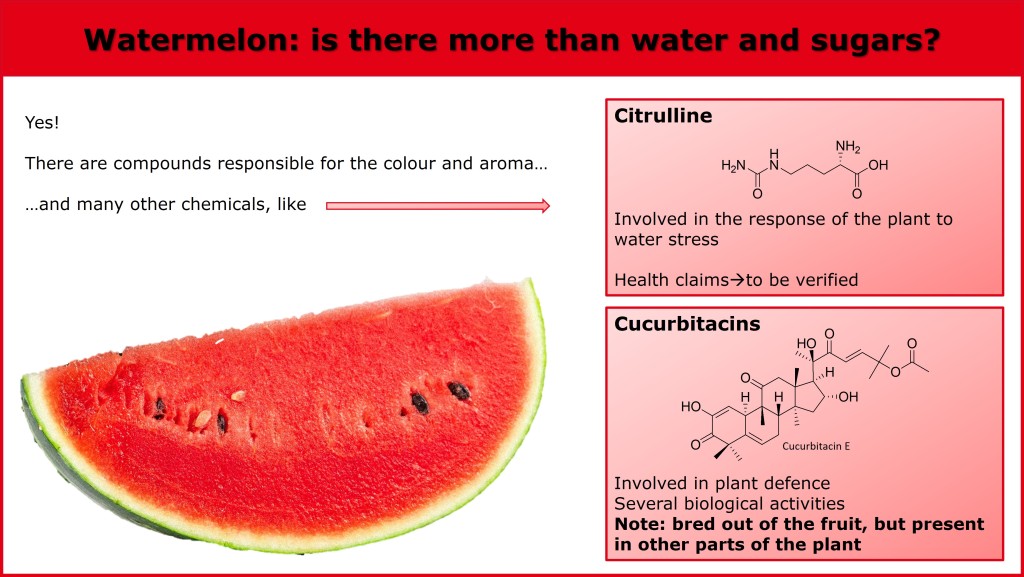
One compound watermelon is particularly rich of is citrulline, a non-essential amino acid which is also synthesized in our body in the urea cycle. Citrulline has been reported from the flesh and, although its quantitative determination might be not accurate due to the limits of the methods that are commonly used, it has also been shown to increase during ripening [4, 5]. It has been actually reported from all parts of the watermelon fruit, including seeds and the rind [4]. Furthermore, it is also very abundant in the leaves, where it is suggested that it could be involved in the protection of the plant from water stress [6].
Citrulline has been reported from other cucurbitaceous fruits including bitter melon, cucumber, muskmelon, pumpkin, etc. [4].
This compound is utilized in the endogenous synthesis of arginine, an important amino acid involved in several functions [4]. There are many health claims related to citrulline, including the fact that it might promote energy levels, however studies to prove them are still needed [7]. While being an amino acid, it is not incorporated into proteins during protein synthesis. However, some proteins do contain citrulline which is obtained through the modification of another amino acid, arginine, normally incorporated during protein synthesis (post-translational modification) [8].
Cucurbitacins
Watermelon also contains several terpenoids, in particular cucurbitacins, characterized by a specific tetracyclic skeleton and often found in plants of the Cucurbitaceae family (to which watermelon belongs). However, during the breeding process, there has been a tendency to select out this trait at least from the fruit, since cucurbitacins are generally bitter in taste [9]. While their concentration may significantly vary depending on the cultivars and on other parameters, it has been shown that they are relatively abundant in the young seedlings [9]. As other terpenoids, these compounds and their glycosides are likely involved in plant defence, but studies are needed to better clarify in which terms [10]. It is also interesting to notice that there are several cucurbitacins and their presence seems to be tissue-specific [9].
Cucurbitacins are also studied for their potential analgesic, anti-inflammatory, antimicrobial, antiviral, and anticancer activities [11], but this topic deserves a dedicated article.
Now it is time to enjoy this end of summer and some tasty watermelon!


 PhytoChem